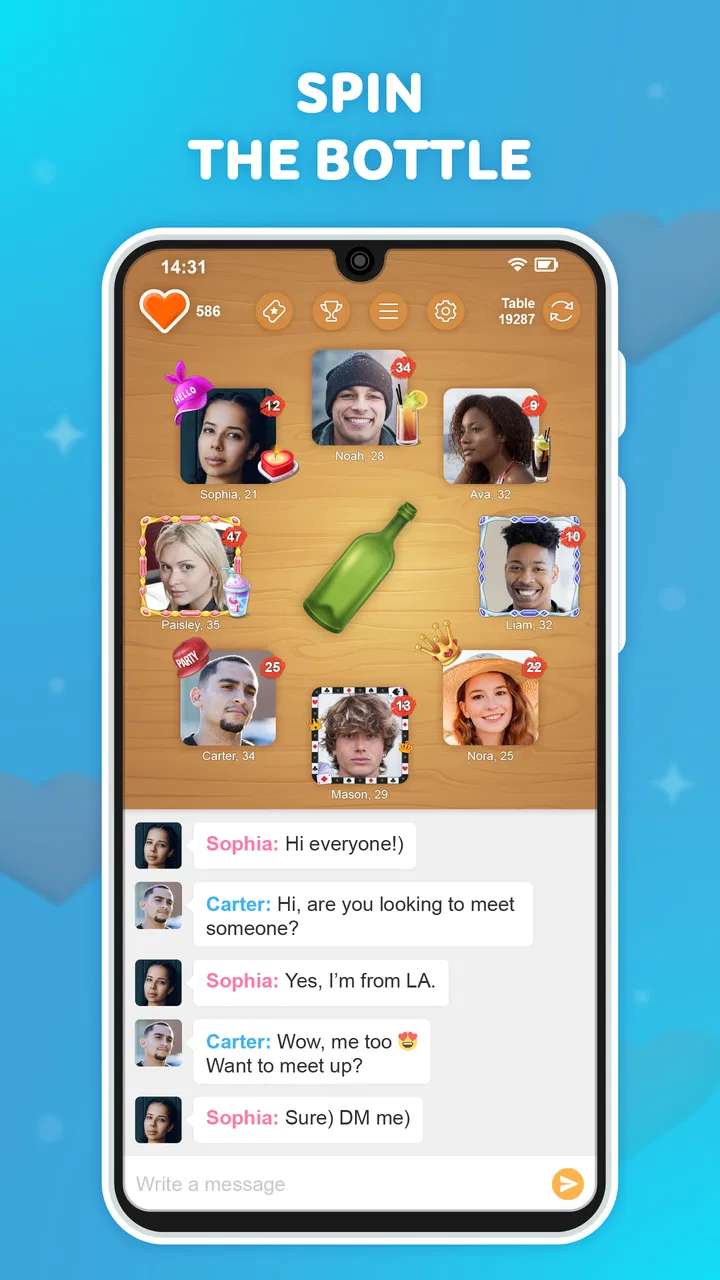
Spin the Bottle: Chatting app
- 3.6
- Rating
- 10.00M
- Installs
- Free
- Price

 Analysis by App-foxy
I approached Spin the Bottle: Chatting app expecting a light social experiment rather than a full messaging platform, and that is the right way to understand it. The app turns the familiar bottle-spinning idea into a way to meet strangers online, start random conversations, and possibly make new friends. It is free to install, but optional in-app purchases range from $0.49 to $119.99 per item, so I would keep that in mind before exploring everything the app offers.
My first impression was that the concept is easy to understand: instead of choosing people from a carefully built profile list, you let chance decide who appears next. That makes the experience more spontaneous than ordinary social networks, although it also makes the quality of each conversation unpredictable. Some encounters feel promising, while others end quickly or do not suit your mood.
What the app feels like when you first open it
This is a social app from Cyboma Limited, aimed at mature users and carrying a 17+ content rating. That age guidance matters because you are interacting with people you may not know, and the atmosphere can be less controlled than in a conventional friend-finding service. I would not treat it as a supervised space for younger users, and I would encourage adults to keep personal boundaries in mind from the first conversation.
You May Also Like

 Pandora - Music & Podcasts
Pandora’s Music Is Easy to Start, but Harder to Recover
Pandora’s strength is its low-effort path from a seed to a station. Its weak spot is how much confidence it asks you to place in connection, setup, and quiet recovery.

 8 Ball Pool
 Is Built on Rivalries, Rematches, and Routine
A close look at the rivalries, rematches, shared routines, and unanswered safety questions that turn a quick pool match into a persistent mobile community.

 Samsung Music
’s Quiet Strength Is Playing What You Already Own
Its reach comes less from spectacle than from dependable access to a personal library. That simplicity is both the app’s strongest retention engine and its ceiling.

 AccuWeather: Weather Radar
AccuWeather Review: A Quick, Clear Forecast for Everyday Decisions
For everyday plans, the best forecast is the one you can understand quickly. AccuWeather makes rain timing, radar, and local conditions easy to act on, with a few trade-offs.

 Hill Climb Racing
Why Hill Climb Racing Still Turns Crashes Into One More Run
A tiny car, a bumpy hill and one more upgrade: Hill Climb Racing keeps resurfacing because its simple chaos makes every near-miss feel personal.

 AliExpress - Shopping App
AliExpress Makes Global Shopping Feel Personal, but Shoppers Bear the Risk
AliExpress turns a global marketplace into a pocket-sized discovery engine. Its reach is useful, its shopping loop compelling, and its trade-offs easy to miss.
More From Our News Desk
View All News


The app has been available since November 8, 2016, and its current version is 3.13.0. It supports devices running Android 7.0 or later. Those details make it accessible on many older Android phones, which is useful if you do not have a recent handset. Still, compatibility alone does not guarantee that every conversation will feel equally active or comfortable; the experience depends heavily on who happens to be available when you use it.
Its social category is important because this is not a traditional game with levels, a story, or a campaign to complete. The bottle is more of a playful interface for starting contact. I found the strongest appeal in the small moment of uncertainty before a new interaction begins. If you enjoy meeting people without planning every detail, that randomness can be refreshing.
On the other hand, people who want a reliable way to find local friends, maintain an organized contact list, or build a carefully filtered dating profile may prefer a more structured service. This app is closer to an open-ended conversation starter than a replacement for a regular messenger or a serious matchmaking platform.
The app has passed the ten-million-install mark and holds an average rating of 3.6 from roughly 102,000 ratings. That combination suggests a broad audience but also a mixed experience. I would read it as a sign that the idea attracts plenty of curiosity, while the results can vary from user to user.
Who is most likely to enjoy it
I think it works best for someone who is comfortable with short, unplanned conversations and does not measure success by making a new close friend every time. It can fill a few spare minutes, give a shy person a low-pressure way to begin chatting, or add variety when ordinary social feeds feel repetitive.
It is also useful for people who want to practise opening lines. Because the other person is not already part of your social circle, you can try a simple question, notice what gets a response, and improve your conversational style without carrying the expectations of an existing friendship. I would keep the tone friendly and general at first rather than immediately sharing personal details.
I would skip it if you dislike uncertainty, become frustrated by conversations that disappear quickly, or expect every match to be interesting. The random format is the central attraction, but it is also the main limitation. A carefully selected community app may be a better fit if shared interests, location, language, or long-term goals are essential to you.
Getting through setup without overthinking it
My advice for a first-time user is to begin with modest expectations. Install the free app on a compatible Android device, open it, and take a moment to understand the social setting before trying to make an impression. There is no benefit in rushing into a conversation with a rehearsed persona. The most useful preparation is deciding what you are willing to discuss and what you will keep private.
A sensible first boundary is to avoid sharing your full name, home address, workplace details, financial information, or private contact details with a stranger. Even if a conversation feels friendly, familiarity can develop faster online than trust deserves. I also would not send personal images simply because someone asks. A polite refusal is enough, and you do not need to justify it.
Before starting, think about the kind of interaction you want. If you are bored, you may be happy with a quick exchange. If you are hoping to make a friend, you will need to give a promising conversation a little more attention. That distinction helps prevent disappointment, because the app can open a door but cannot guarantee that both people want the same kind of relationship.
The mature age rating should shape your expectations as much as the social category does. I would use the app in a private setting, avoid treating new contacts as verified identities, and leave any exchange that becomes aggressive, sexual, manipulative, or simply uncomfortable. The quickest way to improve the experience is to recognise that you are allowed to end a conversation at any time.
A practical way to start your first conversation
For a first attempt, I would use a neutral opener connected to the moment rather than writing a long introduction. Something like asking what brought the person to the app or what they usually do to relax gives them an easy way to respond. It is more effective than sending only “hi,” but it does not demand a detailed answer from a stranger.
Once the other person replies, ask one follow-up question and then offer a small detail about yourself. This creates a balanced exchange instead of turning the conversation into an interview. For example, if they mention music, you could name one style you enjoy and ask what they play most often. The goal is not to impress; it is to discover whether the conversation has a natural rhythm.
A useful, less obvious tip is to treat the first few interactions as a filtering process rather than a verdict on the app. One unresponsive person does not mean the whole service is empty, and one exciting conversation does not mean you should immediately move the relationship elsewhere. Give yourself a few short sessions at different times before deciding whether the random format suits you.
Another practical habit is to end a weak conversation early and kindly. You can say that you are going to move on or simply stop replying if the exchange becomes uncomfortable. Staying in a conversation only because you feel guilty wastes your time and can encourage behaviour you do not want. In a chance-based social app, choosing when not to continue is part of using it well.
What counts as a successful first use
I would define success narrowly: you start one comfortable exchange, learn one interesting thing about another person, and leave without giving away information you would rather keep private. That is a realistic first milestone. It avoids the common mistake of judging the app only by whether you find a lasting friend immediately.
Imagine using it after dinner when you have around ten minutes before another task. You open the app, begin a random chat, ask an easy question, and discover that the other person is also interested in a film genre you like. You discuss it briefly, decide the conversation has reached a natural stopping point, and leave feeling that the time was worthwhile. That is the kind of everyday success the format can deliver.
If the first person is rude or the exchange goes nowhere, the correct response is not to argue. Move on, protect your attention, and try again only if you still feel curious. The app is built around chance, so patience matters more here than it would in a service where you can carefully select every profile.
Where new users can become confused
The biggest source of confusion is the difference between a playful interface and a guaranteed social outcome. The bottle may make meeting someone feel like an event, but the person on the other side is still a stranger with their own mood, schedule, and expectations. A lively start can fade quickly, and a quiet beginning can sometimes become more interesting after a thoughtful question.
It is also easy to assume that a random chat should immediately become a friendship. I found it more useful to view each exchange as a small test of compatibility. If the other person asks questions, respects your boundaries, and keeps the discussion balanced, you may have a reason to continue. If they push for private information or ignore your replies, the random pairing has already given you enough information to leave.
Another point worth watching is spending. The app is free, but it includes paid items, with individual purchases reaching as high as $119.99. I would not buy anything during the first session. First learn whether you enjoy the basic conversation loop and whether the app fits your habits. If you later consider a purchase, check exactly what it changes and set a budget before confirming it.
This is especially important because the excitement of a new match can make optional extras feel more valuable than they are. A purchase cannot make another person interesting, respectful, or available. It may support the way you use the app, but the core quality of a conversation still depends on the people involved and on how both of you communicate.
The rating history also deserves a realistic reading. An average of 3.6 is neither a warning to avoid the app automatically nor proof that everyone will enjoy it. It tells me to expect uneven results and to pay attention to my own experience. The large number of ratings and more than ten million installs show that the concept has reached many users, but popularity does not remove the need for careful judgement.
Safety and privacy habits I would keep
I would never use a random chat as proof that someone is who they claim to be. Keep early conversations inside the app, avoid clicking unfamiliar material, and do not send money or account credentials. If someone tries to rush intimacy, creates pressure, or asks you to keep the interaction secret, I would treat that as a clear reason to stop.
It helps to prepare a few safe subjects before you begin: hobbies, films, food, travel dreams without exact plans, or everyday routines described broadly. These topics make conversation easier while reducing the chance that you reveal identifying details. I would also avoid mentioning where I will be at a particular time or describing a routine that makes me easy to locate.
If a conversation becomes unpleasant, do not stay to prove that you are right. Use the app’s available controls to leave or report the interaction when appropriate, and block contact if that option is presented in your version. The exact controls can change with updates, so I would look at the conversation screen rather than assuming every release places them in the same spot.
There is a social trade-off here: strict boundaries may end a few conversations that could have become harmless, but they also reduce avoidable risk. For me, that is a worthwhile exchange. A good stranger will accept a simple limit without trying to negotiate it.
How it compares with more familiar social apps
Compared with a standard messenger, this app is better at creating a first contact and worse at maintaining an established network. A messenger is useful when you already know whom you want to reach. Here, the appeal is precisely that you do not begin with a chosen contact. That makes it more spontaneous, but less dependable for arranging plans or keeping up with real-life friends.
Compared with a social feed, it offers a more direct conversation and less pressure to publish a polished public identity. You are not simply scrolling through posts and waiting for someone to notice you. At the same time, a feed can help you judge shared interests before speaking, while the random approach gives you much less context. Choose this app when surprise matters more than efficient matching.
Compared with a dating service, it is a looser and less goal-focused experience. Someone may be looking for friendship, casual conversation, or nothing more than a few minutes of entertainment. If you want filters, clear relationship intentions, or a detailed profile-based decision, a dedicated dating app is likely the better tool. Using this app with dating expectations could create misunderstandings.
Compared with interest-based communities, the app has the advantage of lower preparation. You do not need to find the right group before you can talk. The downside is that you may spend more time searching for common ground. An interest community is usually more efficient when a particular hobby is the reason you want to meet people.
Small habits that make the experience better
I would use short sessions rather than leaving the app open indefinitely. A clear time limit keeps random chats from taking over your evening and makes it easier to leave conversations that are not working. It also helps you notice whether you are using the app because you genuinely enjoy it or simply because you are scrolling out of habit.
I would keep my opening message adaptable. Repeating the same clever line to every stranger can make the interaction feel mechanical, while a simple question tied to their first response feels more genuine. The best conversations I can imagine here are not performances; they are quick exchanges where both people contribute.
I would also separate curiosity from trust. It is fine to be interested in someone’s story, but interest is not a reason to share your private accounts or arrange an in-person meeting quickly. If you ever choose to meet a person you encountered through the app, use a public place, tell someone you trust, and keep your own transport and exit plan.
Finally, I would judge the app after several ordinary sessions, not after one unusually good or bad encounter. Random social tools naturally swing between lively and disappointing moments. The question is whether the worthwhile moments happen often enough for you to accept the uncertainty.
My recommendation for a first-time user
I see Spin the Bottle: Chatting app as a casual doorway into unexpected conversations. Its free entry, simple premise, and large user base make it easy to try, while the random format gives it a personality that carefully organised social platforms do not have. I enjoyed the idea most when I treated it as a way to practise conversation and discover a small connection, not as a guaranteed friendship machine.
The app is a reasonable choice if you are an adult who likes spontaneous chats, can handle uneven interactions, and is willing to protect personal information. I would recommend starting slowly, using neutral topics, and postponing any paid purchase until you understand the basic experience. That approach gives you a fair test without turning first-day curiosity into unnecessary spending.
I would choose something else if you need dependable contact with people you already know, strong interest filters, a professional networking environment, or clearly defined dating intentions. Those needs are better served by more specialised apps. The bottle-spinning concept is fun precisely because it removes some control, but that same lack of control makes it a poor fit for users who want predictable results.
My final advice is simple: aim for one respectful conversation, keep your boundaries firm, and let the app remain a lightweight social experiment. When the randomness works, it can turn an ordinary spare moment into a surprisingly pleasant exchange. When it does not, there is no reason to force it. The best way to use this app is with curiosity, patience, and a clear limit on what you are willing to share.
FAQs for Spin the Bottle: Chatting app
01What is Spin the Bottle: Chatting, and how does it work?
Spin the Bottle: Chatting is a social party app that combines the classic bottle-spinning game with conversation prompts and online interaction. Players can spin a virtual bottle to select someone and then answer questions, complete challenges, or start a chat. The exact options may vary by version, so review the available game modes before inviting friends.
02Can I use Spin the Bottle: Chatting with friends, or is it designed for strangers?
The app may support both private sessions with friends and public or random interactions, depending on the selected mode and current features. Before starting, check whether a room is invite-only and review the privacy settings. If you are playing with people you do not know, avoid sharing personal details and leave any conversation that makes you uncomfortable.
03Is Spin the Bottle: Chatting safe for children and teenagers?
Parents should check the app’s age rating, chat functions, content guidelines, and privacy policy before allowing younger users to install it. Games involving random chats can expose players to unsuitable language or unwanted contact. Younger users should play in private rooms with trusted friends, use parental controls where available, and never share their real name, location, school, or contact information.
04Does Spin the Bottle: Chatting require an internet connection or account?
Features such as online chatting, multiplayer rooms, invitations, advertisements, and content updates generally require an active internet connection. Some basic bottle-spinning functions may work offline, but this depends on the app version and device. Account requirements can also differ by platform or game mode, so check the sign-in screen and permissions before creating a profile.
05Is Spin the Bottle: Chatting free to download, and are there in-app purchases?
The app may be available as a free download, but free access can include advertisements, optional purchases, premium prompts, cosmetic features, or other paid content. Pricing and availability can change between Android and iOS. Review the store listing and purchase settings before playing, and enable password or biometric confirmation to prevent accidental charges, especially on shared devices.
Pros
- Simple bottle-spinning mechanic makes starting conversations quick and easy.
- Supports casual icebreakers for parties
- dates
- and group hangouts.
- Chat-focused format can help users connect beyond random questions.
- Lightweight design is generally easy to navigate on mobile devices.
- Offers a playful alternative to conventional messaging apps.
Cons
- Conversation quality depends heavily on the people you are matched with.
- Some prompts may feel repetitive after extended use.
- Random interactions can lead to awkward or unwanted conversations.
- Privacy settings should be checked carefully before sharing personal details.
- The app may feel less useful when few active users are available.

Spin the Bottle: Chatting app
Gallery